BIRDIE (PART 2)
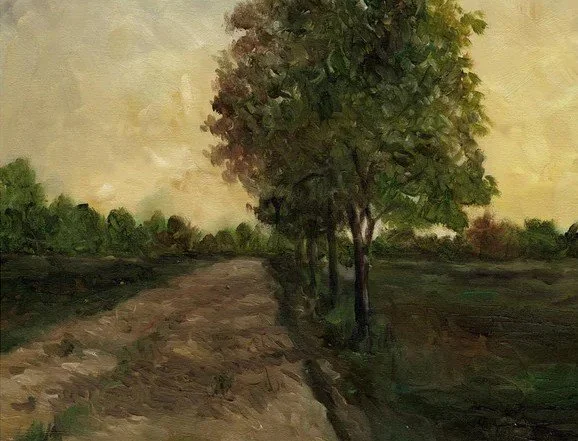
"Morning Sun" by Rich Lo | Greatsketch, all rights reserved.
(Read Part 1)
Amos retreated to the place he thought of as his real home: a 100-square-foot room with only a wooden dresser filled with khakis and folded plaid shirts, and a twin-sized bed sat all the way at the easternmost end of the Hayes’ double-wide. He resigned himself to sitting there for hours, thinking, replaying, analyzing his error. He’d complete this routine until the palpable tension between himself and his mother, and by proxy his father, had dissolved by a reasonable degree. And he intended to do just that. That was, until he had the idea to swing out of his bedroom window and look for that thing he dreamed about the other night.
Amos set out into the backyard, sauntering cautiously along the wet grass until it began to spit rain once again. As the rainfall picked up, Amos sheltered himself quickly inside of the chickens’ incubation shed. This place was kept warm all the time, to let the little baby chicks grow and flap around until they grew big. Amos slid into the back corner of the room, just until the showers passed. The dampness on the back of his flannel shirt helped him slip down the wall into a hunched squat. He sat and observed as the babies learned to keep their balance on legs like pink toothpicks. Holding onto his knees, waiting for the sound of rain to stop rapping against the barn door, he sat quietly for 10 minutes. And then 30. And then an hour.
A new batch must have begun exploring the barn today, because Amos didn’t recognize a few of them. 12 chicks total, he counted, mostly a pale-yellow color. They crowded around his feet like they were happy to see him, unafraid of giants, unaware of what use they served to them. One of these chicks was nearly all black. As it turned around, unaware that it was being watched, Amos noticed something unusual about it. This chick had these stunning buttery-yellow stripes painted all the way up its belly, the color cut off sharply at the chin. He had only seen a few like that before, a baby chick with bright splotches on its breast. But never had he seen one as highly contrasted as this. Amos picked the delicate thing up and held it in the space between the nook of his neck and his right cheek, rubbing his face gently on the smooth feathers of its back. The baby sniffed around his nose, nearly catching his nostril on its open beak. The lightness of the chick’s touch softened Amos’ scrunched expression. This thing, even when trying to nip, was so harmless that its bite felt barely like a tickle. It was nice, Amos thought to himself, to be around things that don’t know how to hurt. In Amos’ kind hands, this chick was held like an offering. How something, so gentle, can make a weak boy feel strong!
The next day, Amos snuck out and found the bird again, waddling around that same corner of the shed. The sight of her caused his heart to swell with joy and excitement, an overwhelming love-surge. For the next morning and the next, he stole moments between chores to go and lift her up, hold her warm softness against his face and say, “I’ll see you tomorrow!” It was magic, Amos thought. It seemed that, for the first time, the boy had something that he looked forward to tending to. Electric—that's how it felt to him to have someone who liked him. A farmer’s work is thankless, the smells repellent, pungent, the scenery beautiful but repetitive. How many times can you look at the same masterpiece before it just starts looking like paint on canvas? Birdie broke that pattern, the deep grooves of monotony which Amos’ young life had already been shaped by. Birdie was fresh. She stood out. A puff of black gunsmoke that drew his eye away from the tedium of the sunshine and those same rolling green hills. That’s what she was. It only took five days for Amos to start talking to the chick like she was a real person.
On that fifth day, he left the empty egg carton on the counter after he snuck a glass of milk for a snack. By noon, he was on the bad end of a sharp smack; he forgot to refill the milk jug after he had finished it. Amos usually ran up into his room when things like this would happen. And they did happen often, him making such stupid mistakes. But today, he ran right past the staircase that led up to his bedroom and out into the backyard, bolting straight into that little red shed and scanning the hay ground to find his Bird. Over the fallen leaves of early October, he ran and ran out of the house where he got thwacked. The wind that enveloped him turned the volume of his father’s voice down, hushing it further as his chunky dogtrot picked up speed: “Little boys who are never calloused, they never learn…” The further away Amos got, the less strong that roaring voice rang, “...they become men like women!” That last part was sticky. Amos thought about it, turning the phrase over in his mind, trying to understand what exactly his father meant: “men like women.” His mother was the only lady he knew particularly well. She seemed just fine. Beyond the fact that Amos wished she would come into his room when he called out for her after waking from a nightmare, she was perfectly up to scratch.
“You were different… you let me hold you,” Amos said to his Bird, having picked her up with a swift scoop and crouched back into that corner where he was protected. He always remembered when someone made him feel like he could exhale. “You followed me around, even when I didn’t have the feed bag.” Amos talked at his Bird in a whisper, as though he didn’t want to make the other chicks jealous. “You’ll be my Birdie…” He said as she chirped towards the shed’s brick-colored ceiling. “…and when you’re big enough, I’ll find a way to hide you in the other barn, so that you never have to be food.” Amos pressed his upturned nose against her pointed beak. Birdie scraped a circle around the space above his lip, pecking lightly at his mouth. Amos laughed deeply from his diaphragm and muttered to her through smiling teeth, “You’re like, my baby.” His heart swelled and his mind lit up at the sight of her like the twinkling sign atop the town cinema, for he had done it, he had found them—the companion he was missing had finally arrived. This someone would be the one to fill the passenger seat in those sweet dreams. He knew it, with a certainty usually reserved for a mother’s intuition, a knowing weaved deep into the crisscross of his nerve endings. He knew it for sure.
Birdie had grown a half-inch taller, her little feet puttering faster now against the compressed hay of the shed floor. Amos found moments between weeding the garden and feeding the hens to sneak in to visit Birdie each afternoon. He would imagine extra tasks and yell out to his mother, “I’ll be out in just a minute!” while sitting in that same corner, telling Birdie what he dreamed about the night before. They say necessity can lead to innovative ideas, and after a week of sneaking into Birdie’s shed, Amos had a clever one. He found the big gallon bags of feed his mother had earlier asked him to bring in and took just a few handfuls out. This will do it, he thought. This should be enough room for Birdie to slide in.
Amos broke open the feed bag, overflowing with seeds that slipped through his cupped hands. He threw handfuls and handfuls of pellet-food over his shoulder, and the hungry chicks that surrounded his ankles thought it might be raining miracles. With one swift dive of his soft hand Amos had nabbed Birdie from her place amongst the chicks, placing her softly into a chick-sized hole in the feed bag. It was almost too easy, how he rolled the top of the paper feed bag over only once, carried it carefully through the front door, set it on the kitchen counter and shifted Birdie in between two bundles of socks in the middle of the clean laundry basket his mom had set out for him to bring up to his bedroom. Birdie tried to flap as Amos transferred her from the clean linens to his bed. “You’re free!” Amos whispered into her ear before setting her down softly on his fresh sheets. Birdie was still moving her teensy wings, trying not to falter as she caught her balance once again.
End of Part 2