BIRDIE (PART 1)
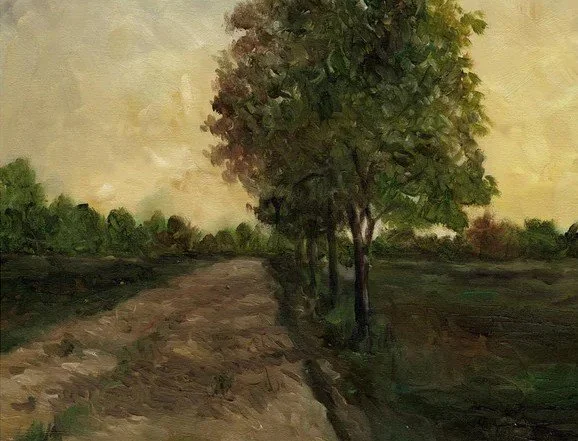
"Morning Sun" by Rich Lo | Greatsketch, all rights reserved.
From birth to the moment of their slaughter, most chickens bred for meat only live about 45 days. These birds, raised to die, have colloquially come to be known as “broilers.” But Amos, a little boy from Fargo, North Dakota, called his chick by a name more tenderhearted. This pet, a little girl-chick of only one day old, would affectionately become known as “Birdie.”
Amos Hayes, born in unlucky 1929, existed during this time in a dreadful state. Most would agree that his position was the most vulnerable a person could ever find themselves in. He was a child, surrounded only by adults.
His mother liked to tell him stories about himself. Stories from a time when he was too young to remember: “You would stare down at the brown leaves on our walk, and you’d try and pick them up, and you’d just cry and cry until I let you carry one.” She’d say, “You would cry even more when they fell off of the branches… imagine that, feeling bad for dying leaves!” He was of the delicate kind, undoubtedly, but it never felt unreasonable to him to be.
Amos was blessed by God with a fine attunement to matters of the heart. Creative and inspired, with the build and constitution of a painter, a thinker. Depth, but no strength. All this is to say, of course, that the little boy was a terrible disappointment to his father.
Living on farmland so vast would make any child feel even more minute. Maybe if there were more people around, some shuffling sounds that filled the house throughout the night, it wouldn’t fill his belly with such dread to try and fall asleep with the door closed. Maybe if he had a brother or sister, someone who he could relate to who knew what it was like to feel small, then he wouldn’t get so overwhelmed when his father got frustrated at his ineptitude with an udder and a steel bucket. Maybe if he had been taken into town more than twice, he would know what to do when he got there. He might know what to say when he saw a group of kids his age playing jacks in the alley and felt that pulling feeling in his chest that told him: “Perhaps they’d like it if I joined them?” But alas, Amos seemed predestined to be the quiet kind. An audience member of life, filling a seat at someone else’s big show.
For someone so indifferent to the temperament of her own son, Amos’ mother seemed particularly interested in matters of clinical psychology. A homemaker since age 21, Celia Hayes had only ever touched the field through old editions from the nonfiction aisle of the town center’s sole book merchant. Some people can’t just listen to the voice in their own head reading the words, they have to recite them in a low murmur under their nose: “Nonetheless, the most core needs of one’s psychological attachment never truly go unmet. They’ll either be fulfilled or they’ll maladapt, in order to achieve some supplementary fulfillment. The mind’s natural hunger for human connection, especially when one has long been starved of it, will always find a way to be fulfilled. Even from a corrupt or inadequate source...” This little habit drove Amos thoroughly, utterly, every-way-to-Sunday crazy. She even annotated these lessons out loud: “What a crock of s—.”
And so, Amos, with 40 acres of empty land and a mind made for dreaming, imagined himself into amusement.
In his mind, life was beautiful. Vibrant rows of tulips in rainbow order filled the plain grass fields outside of his bedroom window. His days were extraordinary, his hours filled with poignant conversations with every calf and fowl who lived alongside him. He read the story about the spider who spun words into her web and gasped in terror when that boar was threatened with death. He imagined that each slice of morning bacon his mother slid onto his dish from a hot frypan came just from the town shops, and before that perhaps was pulled from thin air. His feet were drudging through the slick Dakota grass, his hands gripping a shovel and piling hay from the floor into a wheelbarrow, but his mind could live in another place. Amos was sure that no one in his family had ever dreamed of a life less provincial—that must have been why it hadn’t happened for them. Perhaps if Amos kept imagining a world where he’d grow bigger and work the land real well, he could buy a new car. If he could buy a car, he could drive further and ever further away from these acres, he could see something different for a change.
This world he created, where he was special and that wasn’t such a bad thing, it was where Amos would go to feel warm. He would lay in his bed at night, conjure up an image of a bright blue sky, and him, much older and more assured, in the driver’s seat of a slick red DeSoto. He’d glide as fast as he could above the sodden dirt roads, the matte rubber barely touching the ground beneath him. Amos would smile when he thought of it, and never once thought it strange that in this safe world he imagined himself completely, utterly alone. It didn’t occur to him until he was school age that something might be worth adding to this movie-of-the-mind he visited before nodding off. Someone who was going where he was going. A friend.
That night while Amos was dreaming, a baby chick was born under her mother, a heavy hen of Rhode Island Red. She was a warm chickie, with soft feathers and a mind that only knew to desire feed. An animal both wild and gentle at the same time, capable of ferocity but momentarily helpless. A darling girl, pure and clean and new, possessing in that moment the most perishable quality of all: innocence.
Like all good dads back then, his father subscribed to the belief that thrashing Amos’ small body around would prepare him to meet and overcome the world’s frights. He seemed to give no thought to the fact that attempting to smack the softness out of his heart might result in raising a child who is, instead, terrified to meet the world. Apprehensive about change, resistant to challenges, horrified by mistakes, unnerved by having to try, for trying could lead to error, and error could lead to punishment—this little boy was all of that. And as is common for little boys painted into such a sharp corner, Amos was wholly, irrevocably paralyzed in the presence of his father.
One rainy afternoon in late September, some seven or eight nights after that chick was born, Amos was completing his routine duties of collecting eggs from underneath the laying hens. He was excited this morning, jumping out of bed and running gleefully into the coop of cedar and metal. Collection was fast and categorically easy. A lucky task to have been assigned, given the alternatives. So easy, in fact, that Amos threw the eggs into a leftover carton with joyous abandon, singing a big band tune in his head: “Give my re-gards to Broad-way”—One, then six, then twelve—” Re-mem-ber me to Herald Squaaare”—all of the freshly laid eggs were holding this morning’s breakfast, and all Amos had to do was get them to the kitchen. And a little boy with a mind like his, so bright and optimistic, he wouldn’t just walk through the grass. Oh no, he would skip and throw his head back and see how much of the grey fall sky his eyes could reach up and hold. And on this morning in particular, as he carried this 12-egg carton through the slippy grass atop the slick mud, his daydreaming led to him stepping in such a way that half of his foot perched up at an acute angle over a dirt hummock.
Amos fell forward onto his elbows, the 12-egg carton still clutched in his tense little hands. Now, of course, that 12-egg carton was a six and a half-egg carton. The runny yellow yolk seeped out of the cracked shell, through the hole of the carton and onto his outstretched fingers. The mud under his nails was washed onto his wrist as the clear whites climbed down his hands and into the soil below, dust to dust. His smile fell onto the floor as he walked through the kitchen door with leaden steps, his mother sighing again in unsurprised disappointment when her eyes met his slimy hands. Amos was being pulled across the room by his shirt collar before the clock ticked 8:30 a.m. Grown-ups would argue back then that this might be deserved, even beneficial for the fostering of mental fortitude in a young boy. And they might have been tolerated in arguing that, if it hadn’t been the morning of Amos’ eleventh birthday.
End of Part One