“OPIUM” HIP-HOP IS THIRD WAVE PSYCHEDELIC MUSIC (PART 1)
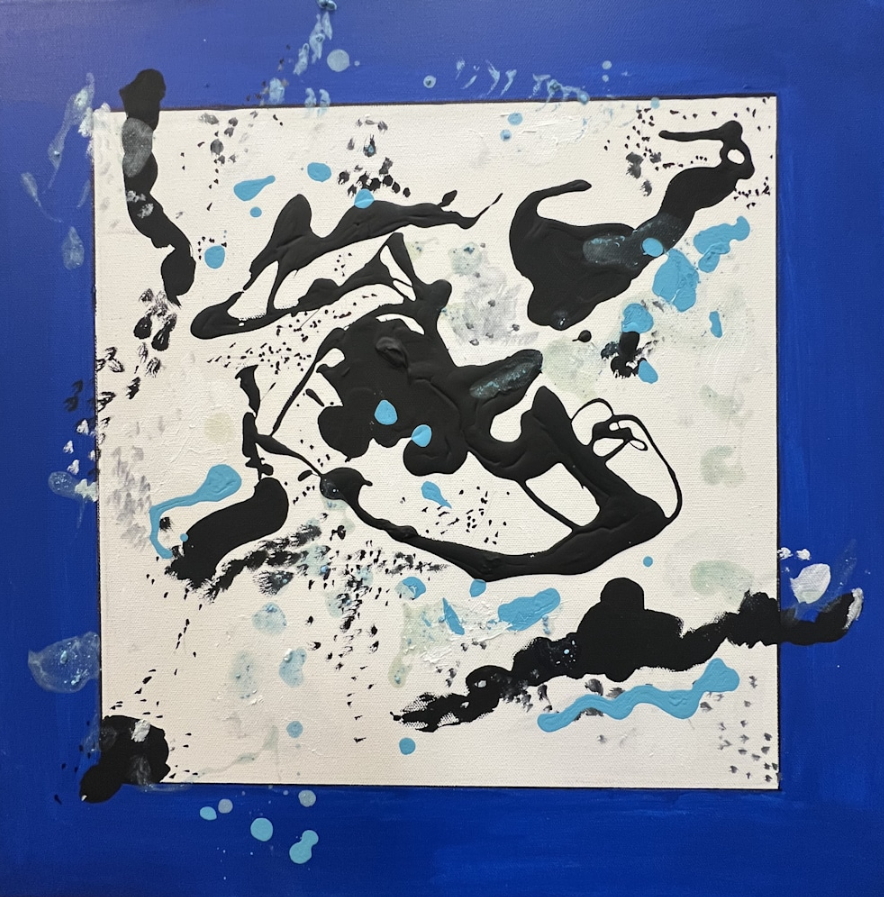
“Freedom” by Marilyn Binder Silverman.
This accompanying artwork is the original, protected, and sole property of artist Marilyn Binder Silverman and held under copyright. Marilyn Binder Silverman’s images, artwork, and content on this website and her website may not be copied, collected, or used for personal or professional gain without written authorization from her.
I didn’t understand kinetic energy until I stood in a stadium with 70,000 Playboi Carti fans and felt the floor shake when “Evil Jordan” detonated. Smoke belched from the stage, strobe lights ripped through the darkness, fireworks cracked overhead, and the crowd didn’t rap along with one of hip-hop’s youngest kings so much as scream.
The spectacle wasn’t just entertainment; it was a controlled dissociation ritual built for an anxious generation raised on screens and SSRIs. In that moment, it was obvious I wasn’t witnessing nostalgia, counterculture, or idealism; I was watching a generation that had its own exit ramp—loud, fast, and ecstatic, with no apologies and no explanations. It was clear I was in for something completely different.
Many generations have felt compelled to manage through their youthful angst with some… help. Sometimes they escape through substances, sometimes through music, sometimes through both at once.
Interestingly, when you look across the past 60 years, you can see three clean eras where drugs, music, and culture fused into one nervous system.
The first was acid rock, born in the mid-1960s. The second was rave culture, born in the late 1980s. The third is what I’m calling “opium,” meaning the modern sedative cloud of sound associated with codeine, Xanax, SoundCloud artists, and Carti’s opium aesthetic (not 19th-century poppy dens).
I’ve settled on three criteria for what counts as a “psychedelic” era:
The music has to acknowledge altered states, explicitly or symbolically.
There has to be a real drug culture around the music: dealers, slang, rituals, identity, not just hobbies.
The drug has to improve the music, or at least shape the perception. The high can’t just coexist with the soundtrack. It has to make the sound better.
Before we even start the journey, though, jazz deserves a short detour. Few would call jazz “psychedelic,” but it was the first laboratory where American musicians tested the limits of time and consciousness. Improvisation stretched beyond song form. Chords dissolved into modal space. In the late 1960s, Miles Davis ran his trumpet through echo chambers and tape loops on In a Silent Way and Bitches Brew, not to imitate guitars or storms, but to fracture time itself. The studio became a mind, the delay a second thought, the tape splice a hallucination you couldn’t quite shake. Guitarists were already bending electricity into weather—Dick Dale, Jimi Hendrix, Led Zeppelin, and others well before them—but Miles was doing something adjacent and stranger: using echo not as volume, but as consciousness. The clubs smelled like cannabis, the bathrooms dripped with heroin, and the music sounded like someone trying to peel the membrane off their soul.
But the drug culture stayed backstage. The crowd stayed sober, mostly. The altered state lived in the performer, not the room. There was no mass youth identity built around intoxication. Jazz altered consciousness but didn’t create the full psychedelic triad.
The First Wave: Acid Rock & LSD (1965–72)
The first wave isn’t controversial. Acid rock was built for LSD. The drugs were LSD, psilocybin, mescaline, and cannabis. The geography was San Francisco, London, and parts of Europe.
The altered state was overt. Psychedelic evangelists did not whisper. Timothy Leary famously told the young to “turn on, tune in, drop out,” compressing a whole worldview into six words. Acid rock was the soundtrack to that command.
The music itself was a revolt against the clock. Jimi Hendrix made feedback sound like prophecy. Pink Floyd used echo like architecture. The Beatles reversed tapes and stretched time. Concerts turned into marathon improvisations. Posters used melting fonts. Head shops sold pipes and Eastern scriptures to teenagers from Ohio who couldn’t tell Sanskrit from Greek but knew they wanted “out.”
The drug culture was not casual. Haight-Ashbury was a full ecosystem. Kids ran away from the suburbs and landed in crash pads. Volunteers handed out tabs in the park. Cops raided the neighborhood while newspapers printed moral panics. The kids stayed anyway.
That third criterion I stated earlier might be where acid rock stands alone. Clinically, LSD bends time, blends senses, and heightens detail. Acid rock matched those neural effects with drones, stereo panning, modal improvisation, and elongated structures. Sober listening hears the structure. Altered listening hears the intent.
Monterey International Pop Festival in 1967 set the template: Hendrix burning his guitar under strobe lights, Janis Joplin turning the blues into exorcism, and Ravi Shankar stretching time with ragas. From there came the Fillmore West and Fillmore East, where Bill Graham booked marathon bills that blurred headliners and openers into one long sensory arc. Light shows from liquid-slide projectors pulsed over audiences while bands like Quicksilver Messenger Service and Big Brother and the Holding Company took modal jams past the 10-minute mark. On college campuses, student unions booked the Grateful Dead, Jefferson Airplane, and Santana alongside experimental filmmakers and poetry readings, turning whole weekends into synesthetic salons.
Cinema caught the wavelength too. “Easy Rider” (1969) braided Steppenwolf and Hendrix into a road-movie elegy for a generation convinced freedom would be found west of the Rockies. “Woodstock” (1970) preserved the sound of acid rock in the wild: Sly & the Family Stone at 3 a.m., The Who playing “See Me, Feel Me” into sunrise, and Country Joe McDonald leading a crowd of 400,000 through a sing-along that felt half protest, half sacrament. Even the quieter films, like Michelangelo Antonioni’s “Zabriskie Point” with its Pink Floyd score, turned deserts, planes, and explosions into meditations on the altered American psyche. Together these concerts and movies formed a shared cultural index: a place where sound, light, and altered consciousness converged into something that felt less like entertainment and more like collective experiment.
Like all utopias, that world collapsed. Musicians overdosed. Others got clean. A few, like Carlos Santana, Paul McCartney, and Neil Young, are bravely championing on. But the pattern had been written: if a drug, a sound, and an identity lock together, a psychedelic wave is born.