SOME QUESTIONS FOR HAN CHI PAINTER MAXINE XU

“The Secret Eternal Love – Destined Beyond Time” by Han Chi Art Gallery, all rights reserved.
“Hi, COOL HAND FRANK, this is artist Maxine Xu, I am glad to know you here from [Living Dead Girl Nicole]. If you have interest, there are stories behind my paintings. I would love to share with you. Thank you.”
Maxine’s message was simple, referential, intriguing. So, I explored her Han Chi Art Gallery website. I was immediately mesmerized by her paintings’ abstract floral shapes bursting with bold watercolor, often atop a formal geometric shape, but always upon a placid background. These were paintings rooted in ancient Chinese history, but they never felt trapped by it. These were paintings at peace with now yet confronting the viewer with exploding movement and transformation.
These brilliant works left me little choice but to interview Maxine. Prepare to have her perspective expand your artistic worldview.
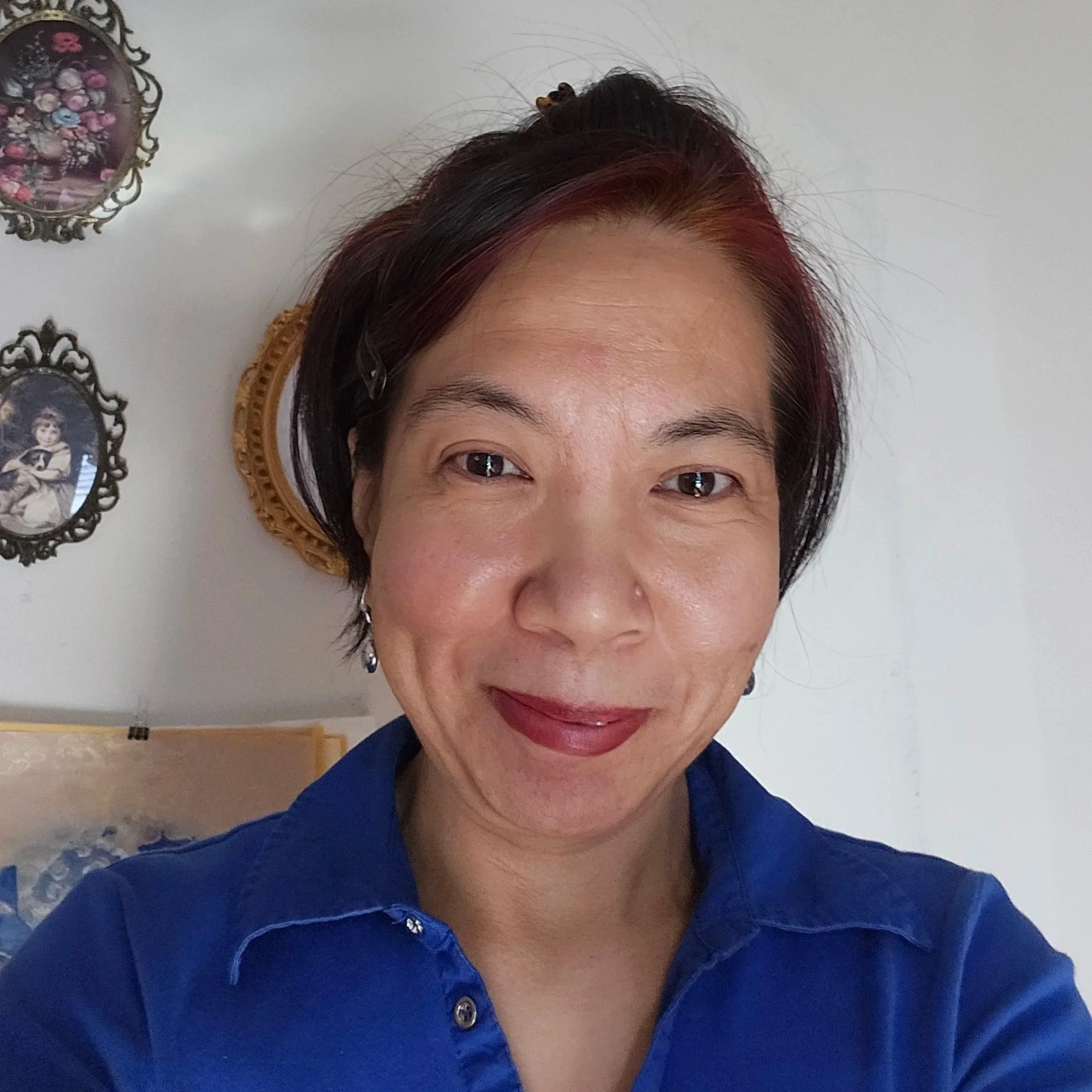
Han Chi Painter Maxine Xu.
Your website's headline proclaims, "Art With Hidden Messages." Which comes first in your artistic process: the visual art itself or the hidden messages, and why?
It is parallel. The visual art and the hidden messages are expressed at the same time. The hidden message is unique for each painting — some of them come from Han Chi, some come from Bird & Worm Scripts, and some from other symbols.
For some paintings, I also hide calligraphy symbolizing Longevity.
What did you discover when you reversed your process?
I could hardly tell you which one goes first; that is why I say it is parallel.
In your Chinese ancestry, jade is considered more spiritually valuable than gold. Your paintings are explicitly influenced by ancient Chinese jade artifacts. Did you consider other gemstones or unrelated mineral rocks before deciding on jade as the focus for your artifact source?
The answer is no. Other gemstones or mineral rocks cannot compare with jade in terms of spiritual value. In the eyes of the ancients, a gentleman compared his virtue to jade.

"The garden of nothingness" by Han Chi Art Gallery, all rights reserved.
Which past and current painters influence you and your style of painting?
I really admire Guanzhong Wu, who was a contemporary Chinese painter widely recognized as a founder of modern Chinese painting. Wu's artworks display both Western and Eastern influences, such as the Western style of Fauvism and the Eastern style of Chinese calligraphy. Wu painted various aspects of China, including its architecture, plants, animals, people, as well as many of its landscapes and waterscapes, in a style reminiscent of the impressionist painters of the early 1900s. His influence helped me develop my own style of painting.
Can you explain Han Chi?
First, let’s talk about the Han Dynasty (汉朝), which existed about 2,200 years ago and was truly a golden age of Chinese culture. It was a time of great growth and wealth when art, literature, and technology all thrived. This era is especially known for its amazing jade carvings. The Han in Han Dynasty Jade represents heavenly craftsmanship.
Next, let’s talk about the Chi, which refers to a Chi-dragon, the second son (龙九子,螭吻居其二) of the nine sons of the dragon. The Chi has the form of a four-legged, long-tailed reptile. It is a popular figure shown on jade carvings.
I combine the Han and Chi and name this group of figures as Han Chi, which includes Chi-dragon, Chi-tiger, phoenix, divines, vermilion bird, tortoise, feathered man, door knocker, etc.
So, Han Chi is not a specific figure itself, but a group of figures all carved in jade artifacts from the Han Dynasty. These magical images, originating from ancient Chinese jade that has been buried underground for millennia, are believed to possess an undying spirit. The profound symbolism and rich history of Han Chi deeply resonate with me, making it a central and recurring subject in my body of work.
How did you first encounter Han Chi in your life?
There is a famous antique market in Beijing called Panjiayuan Antique Market which is not too far from where my parents live. You could find a lot of interesting antiques there. Around 2012, I went there and found many beautiful jade artifacts. The patterns or figures on each piece of jade are different, and they attracted me deeply. (However, some of them are fake; buyers should be cautious.) An idea came to me: why not paint these beautiful figures or patterns in my painting? So, the first one was born.
Where do you find Han Chi showing up most in modern daily life?
Han Chi embodies prosperity, good fortune, happiness, and completeness. I genuinely believe that my paintings embody and radiate these positive energies, offering them to every viewer. In my paintings, those Han Chi images mostly come from precious jade of the Han Dynasty. It is either exhibited in a famous Chinese museum or belongs to a private collection through an auction. One of my paintings, “Eternal Love,” is inspired by a Han Dynasty “chicken heart” jade pendant. This painting embodies eternal love between soulmates. This particular pendant was auctioned for HK$1,386,000 at Christie’s auction in 2022. What’s more, wearing jade is believed to offer a range of benefits in modern daily life, including protection from evil and misfortune, health support, attracting wealth and good fortune, enhancing beauty and skin vitality, and promoting emotional balance.

“The Ring of Return” by Han Chi Art Gallery, all rights reserved.
You categorize your online store into Han Chi Art, Digital Art, and Abstract Art. How does your abstract art differ from Han Chi art?
Abstract art does not contain any figures or patterns of Han Chi. Some are a combination of abstract art with my calligraphy or Chinese hieroglyphics.
How do you get yourself "in the zone" to paint?
I turn the music on, which helps me stay away from 3D, and my mind can freely play in 5D.
What's your beverage of choice while painting?
I don’t drink any beverage while painting!
This interview has been edited for clarity and fully approved by Han Chi Art Gallery and Maxine Xu.