THE “ART” OF NONCHALANCE
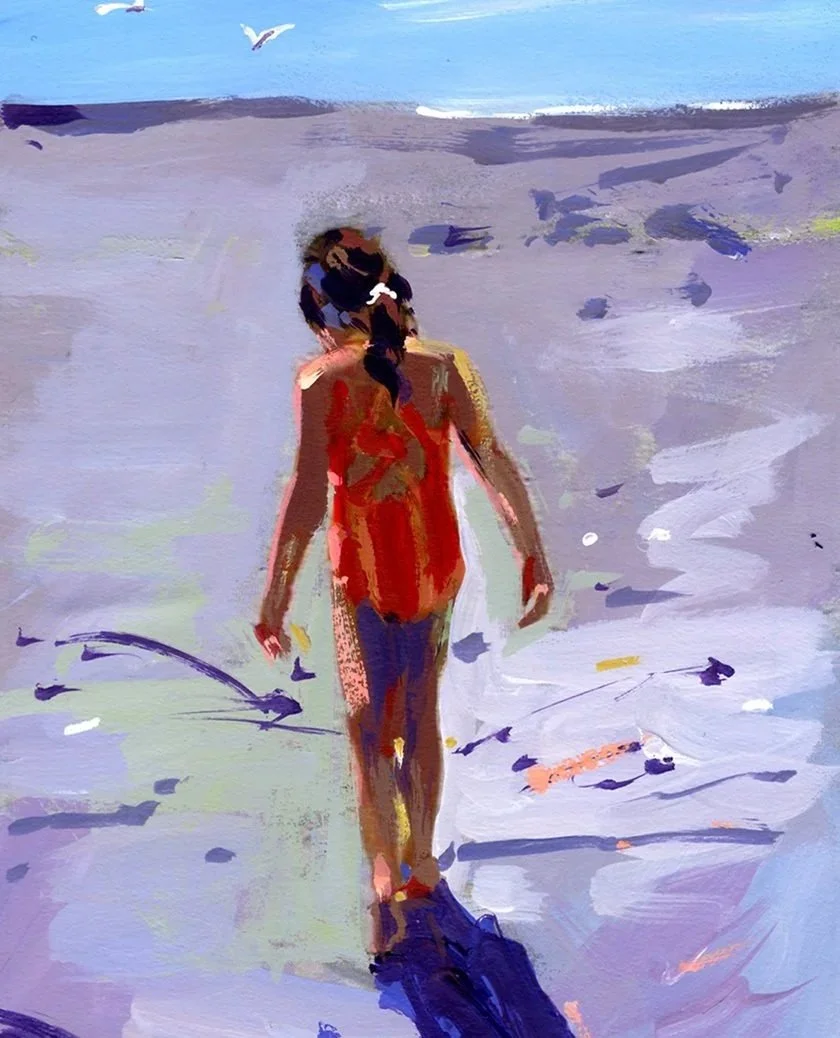
"THE SHELL SEEKER" by Ray Brilli Fine Art, all rights reserved.
This accompanying artwork is the original, protected, and sole property of artist Ray Brilli Fine Art and held under copyright. Ray Brilli Fine Art’s images, artwork, and content on this website and his website may not be copied, collected, or used for personal or professional gain without prior written authorization from him.
“Nonchalance is hot.”
But why?
Well, to figure it out, we have to find out just what it means.
Nonchalant: having an air of easy unconcern or indifference
It’s the last word – indifference – that does the heavy lifting. Not confident. Not calm. Not charm. Pure indifference towards others, foes, and even… you. Yet somehow, that is exactly what people seem to be drawn to and exactly what the modern person wants to be.
But why? Why does “I don’t care” win?
Because people are pulled toward the unknown.
There’s something deeply compelling about not having the full picture. With someone’s features sculpted into a cold expression, you can’t read them. Their thoughts and feelings aren’t readily available, so instead, you start filling in the gaps.
You imagine. You project. You build a version of them out of fragments. They like to read, although you’ve never seen them with a book in hand (they simply exude the nerdy type). They go on a run every morning. They have a perfect life. Maybe they also journal in a sunlit café and have never once checked their screen time.
Often, that imagined version is more interesting, more perfect, more magnetic than reality could ever sustain.
It used to be easier to exist partially unknown.
Before social media, people were naturally mysterious. Not intentionally but just by default. You didn’t know what someone did over spring break unless they told you. You didn’t see their late-night thoughts, their playlists, their every opinion documented. You learned people slowly, through conversation, through chance encounters, through what they chose to reveal.
There were gaps, and those gaps mattered because they gave space for curiosity to grow. Now, those gaps have mostly disappeared, especially for Gen Z, who have grown up with constant digital documentation of their lives and identities.
You can scroll through someone’s life in minutes. You can see where they’ve been, what they think, who they’re with, and what they care about. So in a world where so many are constantly revealing themselves, mystery has to be performed and sought out.
And that’s where nonchalance comes in.
If you can’t be unknown, you can at least seem unreadable. If your life is visible, your inner world doesn’t have to be. Acting like you don’t care becomes a way to reintroduce distance. To recreate that feeling of there being something just out of reach.
Nonchalance, then, isn’t really about indifference. It’s about withholding.
It’s about resisting the urge to explain yourself fully. Not reacting right away. Not offering everything up at once.
And for a lot of people, the easiest way to do this is to seem like they don’t care.
Because caring is visible. Caring makes you easy to read and understand. The more you care, the more you reveal. Your interests, your intentions, your vulnerabilities. Indifference, on the other hand, blurs those edges. It keeps people guessing.
It allows people to build the perfect version of someone else, because, for once, not everything is known.
The catch? The same mystery that pulls people in can quietly start pushing them away.
When someone starts performing nonchalance in order to seem mysterious, it can diminish into emotional distance. The delayed replies, the vague responses, and the curated aloofness all build coldness that doesn’t allow for intimacy to blossom.
Emotional connections need a sense that both people are present. When all there is are calculated pauses or emotional ambiguity, it breaks down, and the connection stops feeling mutual and starts feeling like a chore.
Nonchalance introduces hesitation where there should be ease.
Instead of saying what you mean, you say what you think will please. Instead of responding when you want to, you wait. And the other person feels that, not necessarily as a clear rejection, but as a kind of absence, as your own form of nonchalance.
So they adjust too, and the cycle keeps going until a connection which could have been something real and genuine becomes a story you tell friends.
It might feel intriguing at first, even addictive in its inconsistency, but it doesn’t deepen. There’s no accumulation of trust, no sense of being known. Just a constant loop of guessing, imagining, and waiting.
The irony is that the very thing people use to draw others in, curated indifference, can end up preventing the kind of closeness they actually want. Because while mystery might spark attraction, it certainly doesn’t sustain it.
You can’t build something real with someone who is always just slightly out of reach… at some point, someone has to care a little “too much.”